
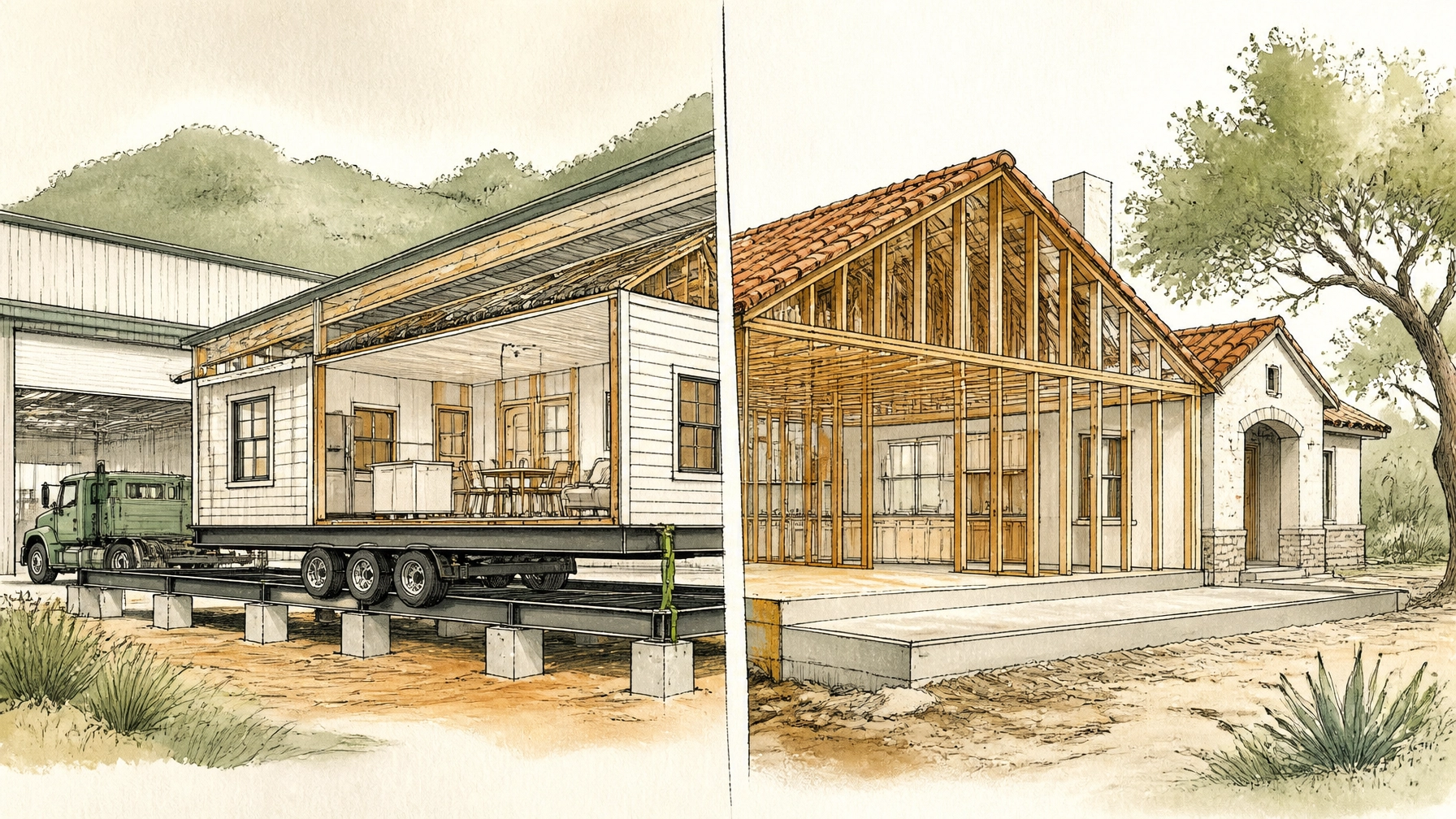
When people imagine retirement in New Braunfels, they may picture a limestone ranch home, a shaded porch, or a peaceful place near the rivers and Hill Country trails. But traditional site-built homes are not the only option worth considering.
Modern manufactured homes can offer efficient layouts, lower-maintenance living, and access to welcoming communities. Traditional homes may provide more customization, familiar financing options, and broader choices for long-term resale. Neither is automatically the “right” answer. The better choice depends on how you want to live, where you want to live, and what you want your home to do for you in retirement.
Here is a neutral look at the differences.
First, What Is a Manufactured Home?
A manufactured home is built in a factory according to federal U.S. Department of Housing and Urban Development standards. It is then transported to the home site and installed on a foundation or anchoring system.
That is different from a traditional site-built home, which is constructed on the lot according to applicable local building codes.
Texas also has a third category worth understanding: the modular or industrialized home. According to the Texas Department of Licensing and Regulation, industrialized homes are built to the same codes as site-built homes, must be installed on a permanent foundation, and are treated differently from HUD-code manufactured homes.
The labels matter because they can affect site requirements, financing, insurance, resale, and local approvals. Statewide and local rules vary, so buyers should verify details with qualified housing professionals before making a decision.
Construction: Factory Precision vs. On-Site Building
Manufactured homes are constructed indoors, where the building process is less exposed to rain, wind, and other weather delays. Components are produced in a controlled environment and inspected throughout the process before being delivered to the property.
That does not mean every manufactured home is identical: or that every site-built home is superior. Materials, craftsmanship, installation, maintenance, and the specific builder all matter.
Research discussed by the Texas Real Estate Research Center notes that modern manufactured homes can be comparable in quality to site-built homes when properly maintained. Today’s designs may include open kitchens, spacious bathrooms, energy-conscious features, porches, and upgraded finishes.
Site-built homes offer a different experience. Construction happens on the property, allowing more flexibility for custom floor plans, unusual lots, specialty rooms, detached workshops, and architectural details. The tradeoff can be a longer, more involved building process with more decisions and contractors to coordinate.
For some retirees, factory construction sounds refreshingly simple. For others, choosing every detail of a custom home is part of the fun.
“Modern manufactured homes are shedding old stereotypes and gaining ground in the housing market,” according to the Texas Real Estate Research Center’s recent overview of the category.
Maintenance and the Value of a Simpler Saturday
Retirement is supposed to create more time for river walks, coffee with friends, and the occasional afternoon nap: not necessarily more time wrestling with a mower.
Many manufactured homes are designed with practical, single-level layouts and manageable footprints. That may mean less exterior surface area, less landscaping, and fewer rooms to maintain. Some communities also provide shared maintenance or landscaping services, although the exact arrangement varies.
Traditional homes can also be low-maintenance, particularly when they are newer or located in communities with well-managed common areas. But a larger site-built home may come with more roof area, landscaping, exterior finishes, storage spaces, and systems to maintain.
When comparing homes, look beyond the purchase price. Ask:
- How much yard work will be required?
- Who maintains the roof, exterior, driveway, and common areas?
- How old are the HVAC, plumbing, and electrical systems?
- Will the home be comfortable during a Central Texas summer?
- Are replacement parts and qualified repair professionals readily available?
A home that looks affordable on closing day may feel very different after several years of repairs and upkeep.

Community Settings and Daily Lifestyle
Manufactured homes may be located in land-lease communities, age-oriented communities, rural settings, or on individually owned lots. A community setting may include shared amenities, walking paths, a clubhouse, or regular social activities.
That can be appealing to retirees who want built-in opportunities to meet neighbors. It may also provide a sense of structure without requiring every social outing to begin with a drive.
Traditional homes offer a wider range of settings. You might choose an established neighborhood, a newer subdivision, a home near downtown New Braunfels, or a property with more privacy outside the city. Some communities have HOA services or amenities, while others leave nearly everything to the homeowner.
Think about your preferred rhythm:
- Do you want neighbors nearby or more space between homes?
- Would you enjoy community events and shared amenities?
- How important is privacy?
- Do you want room for visiting family, hobbies, or a workshop?
- Would a lock-and-leave home make travel easier?
New Braunfels offers an appealing mix of outdoor recreation, historic districts, dining, and community activities. Your housing choice should support how you plan to enjoy those things. Our guide to adjusting to the slower pace of New Braunfels may help you think through the lifestyle side of a move.
Financing: Ask Questions Before You Fall in Love With the Floor Plan
Manufactured-home financing can be more complicated than financing for a traditional site-built home. The details may depend on whether you own the land, how the home is classified, the foundation, the home’s age, and the lender’s guidelines.
Some manufactured homes are financed together with the land as real property. Others may involve a different type of loan when the home is located on leased land or is not permanently affixed. Terms, rates, down-payment requirements, and eligibility can vary.
Traditional site-built homes generally have broader access to familiar mortgage structures, but buyers still need to consider their income, assets, credit profile, existing obligations, and long-term retirement budget.
Before signing a contract, ask a qualified lender:
- What type of financing applies to this specific home?
- Is the land included?
- How does the foundation affect eligibility?
- Are there restrictions related to the home’s age or location?
- What happens if you later want to refinance or sell?
This is a planning conversation, not a reason to assume one housing type is universally better. The goal is to understand the full cost and structure before moving forward.
Insurance and Property-Related Questions
Insurance availability and pricing can vary for both manufactured and traditional homes. Manufactured homes may require specialized coverage, and the policy can depend on the home’s age, installation, foundation, location, and exposure to risks such as wind, hail, flooding, or fire.
Traditional homes typically use standard homeowners policies, but premiums can still differ significantly based on construction materials, roof age, claims history, location, and replacement costs.
Before purchasing, request an insurance estimate for the actual property: not a rough estimate based on a similar home. Also ask what is covered for:
- The home and attached structures
- Personal belongings
- Water damage
- Storm damage
- Temporary living expenses
- Liability
- Community or shared-property responsibilities
A conversation with an insurance professional can help you avoid an unpleasant surprise after closing.
Resale and Long-Term Flexibility
Resale is one of the most important differences to investigate carefully.
Traditional homes on owned land generally have a broader pool of future buyers and more established appraisal comparisons. Their resale prospects will still depend on location, condition, design, neighborhood, and the broader housing market.
Manufactured homes can hold value well when they are modern, properly maintained, well-located, and installed in a desirable community. However, resale may be affected by the land arrangement, foundation, community rules, age, financing availability, and the supply of comparable homes.
A manufactured home on leased land may have a different resale process from a manufactured home and land sold together. Community rules may also affect buyers, renovations, rentals, or the timing of a sale.
If you expect to move again, leave the home to family, or consider housing equity as one part of your long-term retirement picture, discuss those goals early with your real estate, legal, tax, and financial professionals.
Accessibility and Aging in Place
Both housing types can work well for aging in place, but accessibility should be evaluated before purchase: not after a mobility change.
Look for:
- A step-free or low-step entrance
- One-level living
- Wide, comfortable hallways and doorways
- A primary bedroom near the main living area
- A bathroom that could accommodate future grab bars
- A walk-in or roll-in shower
- Good lighting and minimal thresholds
- Convenient parking and pathways
- Space for visiting family or in-home support
Many manufactured homes offer practical single-story layouts. Traditional homes can be customized or renovated for accessibility, though modifications may add cost and construction time.
The best home is not necessarily the largest one. It is the one that remains comfortable, usable, and welcoming as your needs evolve.

A Simple Comparison
| Consideration | Manufactured home | Traditional site-built home |
|---|---|---|
| Construction | Factory-built under HUD standards | Built on the property under local codes |
| Layout | Often efficient and single-level | Broad range of layouts and customization |
| Maintenance | May be more manageable, depending on size and community | Varies widely by age, size, and property |
| Community options | Land-lease, age-oriented, rural, or owned-lot settings | Neighborhoods, subdivisions, rural properties, and HOAs |
| Financing | May require additional classification and lender questions | Usually more familiar mortgage structure |
| Insurance | Coverage and availability can vary by home and installation | Typically standard homeowners coverage, subject to underwriting |
| Resale | Influenced by land ownership, community rules, condition, and location | Influenced by location, condition, design, and market demand |
| Accessibility | Often practical for one-level living | Can be built or modified for accessibility |
| Lifestyle fit | Efficient, social, and potentially lower-maintenance | Flexible, customizable, and varied in privacy and space |
The Bottom Line: Choose the Home That Supports Your Retirement
Manufactured homes and traditional homes can both be sensible retirement housing options. The right choice depends on your priorities: not on outdated assumptions.
A manufactured home may appeal if you value efficiency, community, a simpler footprint, and potentially lower upfront housing costs. A traditional home may be a better lifestyle fit if you want greater customization, more land or privacy, or a familiar resale and financing environment.
Before deciding, visit properties in person, review community rules, obtain insurance estimates, ask detailed financing questions, and consider how the home will serve you five, ten, or twenty years from now.
Retire in New Braunfels is a community and lifestyle resource for people exploring the Hill Country. At Mau Sanchez Capital, we specialize in helping families think through the financial transitions that may accompany a move, including how housing decisions fit into a broader retirement picture. Our approach generally emphasizes transparent, liquid, publicly traded markets, thoughtful asset allocation, and client-specific portfolio design rather than unnecessary complexity.
For personal tax questions, consult a qualified CPA. For title, contract, estate, or legal questions, consult an estate attorney or other qualified legal professional. Mau Sanchez is a Retirement Planner and Investment Manager: not a tax advisor or estate planning attorney.
Ready to connect your housing decision with the rest of your retirement picture? Learn more about Mau Sanchez Capital or schedule a private conversation.
Schedule a private meeting with a fiduciary financial advisor today by calling (512) 593-8380 or by visiting: https://calendly.com/portafoliocapital/15min
Portafolio Capital Management dba Mau Sanchez Capital is a Registered Investment Adviser. This content is for informational purposes only and does not constitute investment advice or a solicitation to buy or sell any security. Advisory services are provided only pursuant to a written advisory agreement.
This article may include stories, scenarios, and perspectives created or assisted by artificial intelligence. Although the individuals and circumstances described may be fictional, the topics are intended to reflect real financial, personal, and lifestyle issues that retirees and individuals commonly face.
The content is provided to encourage readers to consider different perspectives that may affect their retirement, regardless of whether they are currently planning, approaching retirement, or already retired. It is intended for general educational and informational purposes only and should not be interpreted as personalized investment, financial, tax, legal, medical, or retirement-planning advice.
Individual circumstances vary. Readers should independently verify any information presented and consult appropriately qualified professionals before making financial or personal decisions. No advisory, professional, or client relationship is created through the use of this website.
Leave a Reply