
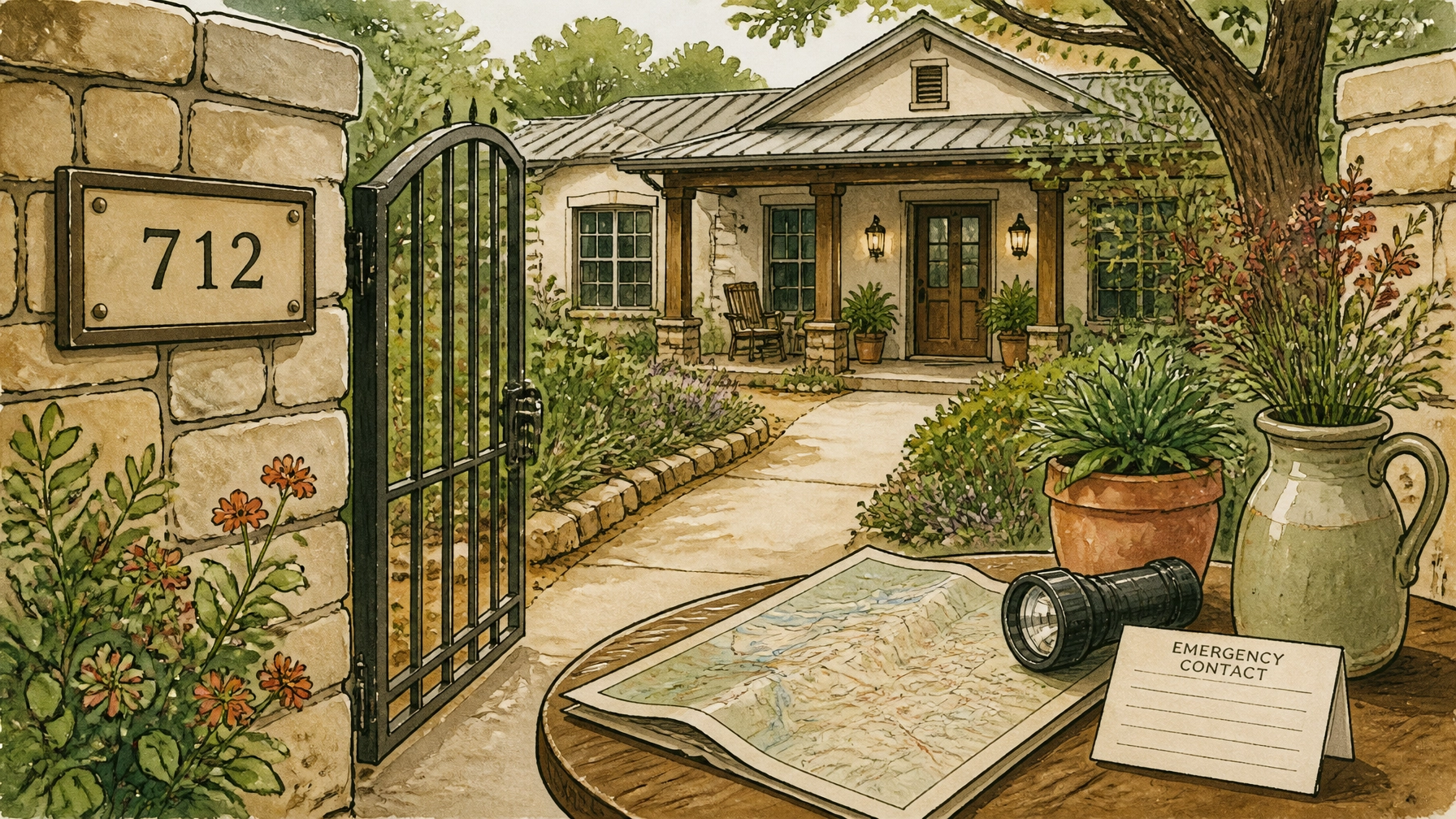
When comparing retirement homes in New Braunfels, it is easy to focus on the enjoyable details: the covered patio, the nearby coffee shop, the golf cart-friendly streets, or how quickly you can reach Gruene for dinner.
Those details matter. But one practical question deserves equal attention:
How easy would it be for emergency services to find and reach this home?
This article is intended as general educational information to help you evaluate lifestyle and preparedness factors as you compare properties. It is not tax, legal, medical, or emergency-response advice.
You cannot guarantee a response time or predict the outcome of an emergency. Weather, traffic, call volume, road conditions, and the nature of the situation can all affect what happens. Still, you can evaluate the home’s access, visibility, communication systems, and preparedness before you move.
Here is a practical checklist for reviewing emergency-service access when choosing a New Braunfels retirement home.
1. Start with the exact property address
A beautiful Hill Country home can still be difficult to find if the address is confusing, shared with another driveway, hidden by landscaping, or located behind a gate.
Before making an offer or signing a lease, confirm:
- The complete street address
- The official 911 address
- Whether the home is inside New Braunfels city limits or in unincorporated Comal County
- Whether the driveway entrance and the home have separate identifying numbers
- Whether the property is part of a larger community with multiple streets, buildings, or cottages
- Whether the address appears correctly in online mapping applications
Ask the seller, property manager, homeowners association, or community operator whether the address has been verified for emergency dispatch purposes. If there is any uncertainty, contact the appropriate local authority rather than relying on a real estate listing or a familiar nickname for the property.
The City of New Braunfels Emergency Management page and Comal County Emergency Management office are useful starting points for local preparedness information and contacts.
2. Check whether responders can see the home at night
Address visibility is one of those small details that becomes very important when every minute feels long.
Walk or drive past the property from both directions during the day and after dark. Look for:
- Large, high-contrast numbers
- A reflective plaque or lighting near the driveway
- Address numbers on the home itself
- A separate marker at the entrance if the home sits far back from the road
- Clear visibility through gates, fences, trees, and landscaping
- Numbers that can be read without stopping directly in front of the home
For a rural or semi-rural property, a sign at the driveway may be more useful than numbers mounted only on the front porch. If the driveway is long, narrow, curved, or shared, ask how responders distinguish the home from neighboring properties.
Also check whether seasonal growth could hide the sign. Hill Country landscaping has a way of becoming enthusiastic. A sign that is visible in January may disappear behind foliage by July.

3. Review road access and driveway conditions
Emergency access is not just about distance. It is also about the final stretch between the public road and the front door.
During a property visit, inspect:
- Driveway width and surface
- Steep grades or sharp turns
- Low-water crossings
- Bridges, culverts, or areas that collect water
- Gate access and keypad procedures
- Clearance for emergency vehicles
- Street parking that could narrow the route
- Construction zones or roads that are frequently blocked
- Lighting along the driveway and entry path
- Whether the home has more than one practical route in or out
If you are considering a home near a river, creek, or low-lying road, ask how heavy rain affects access. The Comal County floodplain and construction resources can help you begin reviewing flood-related property questions. You can also use the county’s available mapping resources, but remember that an online map is an initial screening tool: not a substitute for asking the appropriate county office for property-specific information.
The goal is not to eliminate every possible inconvenience. It is to understand what the access looks like on an ordinary day, during heavy rain, and after a storm.
4. Learn how local alerts reach the household
New Braunfels and Comal County provide several ways for residents to receive emergency information. The city’s Emergency Management resources include local preparedness and alert information, while the county operates a Regional Emergency Notification System.
Ask:
- Can residents register their own mobile phones?
- Does the community help residents enroll in local alerts?
- Are alerts delivered by text, phone call, or email?
- Who monitors alerts if the resident is asleep, traveling, or unable to use a phone?
- Are there backup communication methods during a power or internet outage?
- Does the community have a written process for notifying family members?
The city also provides information about outdoor warning sirens. Sirens are intended to warn people outdoors in certain areas and situations, so they should not be treated as the only alert method for someone inside a home.
As Comal County’s flooding guidance explains, “If officials tell you to leave, do so immediately.” Review the county’s Tips for Flooding Events before you need them.
5. Ask about evacuation and shelter plans
A retirement home should have a practical plan for severe weather and other disruptions: not just a cheerful brochure with the word “preparedness” printed in large type.
Ask the owner, property manager, or community director:
- What is the plan for flooding or flash flooding?
- How are residents notified if evacuation is recommended?
- Which exits and roads would residents use?
- Are there alternate routes if the primary road is blocked?
- How would residents with limited mobility leave safely?
- Is transportation available if residents cannot drive?
- Where would residents go temporarily?
- How are pets handled?
- How are family members notified?
- How often is the plan reviewed?
For an independent home, create your own simple plan. Keep a written list of family contacts, the name and address of your property, any important household information, and a meeting location outside the immediate area.
Do not assume that the most familiar route is always the safest route. During flooding, official instructions may change quickly. Follow current guidance from local authorities rather than attempting to improvise around barricades or standing water.
6. Understand the home’s backup power and lighting
Power interruptions are not always dramatic, but they can make a home much harder to navigate and communicate from.
When touring a property, ask:
- Is there a whole-home generator or another backup power system?
- Which systems remain operational during an outage?
- Are exterior lights connected to backup power?
- Are garage doors and gates operable without electricity?
- Is there a battery-powered radio?
- Are flashlights easy to reach?
- Is there a safe place to keep spare batteries?
- Can phones and other essential devices be charged?
For a community or assisted-living setting, ask specifically how long backup systems are designed to operate and which areas receive priority. Avoid assuming that a generator powers every appliance, room, elevator, or gate.
For a private home, keep a flashlight near the bed, another near the main entrance, and a small emergency kit in a known location. Practical beats fancy every time.

7. Map hospitals, emergency departments, and pharmacies
Emergency-service access also includes knowing where you would go after leaving the home.
Map the property to nearby emergency departments under:
- Normal traffic
- Weekend traffic
- Severe-weather conditions
- Major event or festival traffic
- Potential road closures
For reference, CHRISTUS Santa Rosa Hospital – New Braunfels lists its emergency department at 600 North Union Avenue and provides 24/7 emergency services. CHRISTUS Santa Rosa Emergency Center – Creekside is another local emergency-care location.
These links are provided as starting points for location research, not as a recommendation or guarantee of availability. In a life-threatening emergency, call 911 and follow the dispatcher’s instructions.
For everyday preparedness, identify nearby pharmacies and ask about:
- Hours of operation
- Prescription pickup and delivery
- Weekend and holiday access
- What happens if the primary pharmacy closes temporarily
- Whether the home or community has a process for medication deliveries
A pharmacy’s proximity is useful, but its hours, delivery options, and backup procedures may matter just as much.
8. Ask local officials and providers direct questions
Before choosing a home, make a short call list. Depending on the property, you may want to contact:
- The city or county emergency management office
- The property’s homeowners association or manager
- The local utility provider
- The community’s security or gate operator
- Nearby hospitals or emergency departments
- Local pharmacies
- Your insurance professional for property-specific questions
Good questions include:
- Is this property’s address correctly recognized for emergency dispatch?
- Are there access restrictions that responders need to know about?
- Are there known flood-prone roads near the property?
- How can residents receive local emergency alerts?
- What should residents do if a gate, bridge, or low-water crossing is closed?
- Which emergency routes are recommended for this neighborhood?
- Does the property have a documented evacuation or outage plan?
Keep written notes and compare answers across homes. A simple checklist can make the difference between remembering what felt pleasant and understanding what is actually practical.

9. Include emergency readiness in your relocation plan
Emergency access is one part of a larger New Braunfels retirement decision. You may also want to consider home maintenance, travel plans, access to daily conveniences, and how the property fits your desired pace of life.
At Mau Sanchez Capital, we specialize in helping families think through the financial transitions that can accompany a move, including how a new housing choice may fit into a broader retirement plan. Our approach emphasizes client-specific planning, liquidity, transparency, and properly constructed portfolios using publicly traded markets when appropriate.
This is not about predicting every storm or planning for every unlikely event. It is about choosing a home that works well on ordinary days: and gives you a clearer plan when the day is not ordinary.
Final thoughts
New Braunfels offers an appealing retirement lifestyle: river walks, Hill Country scenery, friendly neighborhoods, local dining, and plenty of reasons to spend more time outdoors.
As you compare homes, add one less glamorous but highly practical question to your list:
Can emergency services easily identify, access, and communicate with this property?
Check the address. Walk the driveway. Review the routes. Register for alerts. Ask direct questions. Then return to the enjoyable decisions: like where to put the patio chairs.
Schedule a private meeting with a fiduciary financial advisor today by calling (512) 593-8380 or by visiting: https://calendly.com/portafoliocapital/15min
Portafolio Capital Management dba Mau Sanchez Capital is a Registered Investment Adviser. This content is for informational purposes only and does not constitute investment advice or a solicitation to buy or sell any security. Advisory services are provided only pursuant to a written advisory agreement.
This article may include stories, scenarios, and perspectives created or assisted by artificial intelligence. Although the individuals and circumstances described may be fictional, the topics are intended to reflect real financial, personal, and lifestyle issues that retirees and individuals commonly face.
The content is provided to encourage readers to consider different perspectives that may affect their retirement, regardless of whether they are currently planning, approaching retirement, or already retired. It is intended for general educational and informational purposes only and should not be interpreted as personalized investment, financial, tax, legal, medical, or retirement-planning advice.
Individual circumstances vary. Readers should independently verify any information presented and consult appropriately qualified professionals before making financial or personal decisions. No advisory, professional, or client relationship is created through the use of this website.
Leave a Reply