
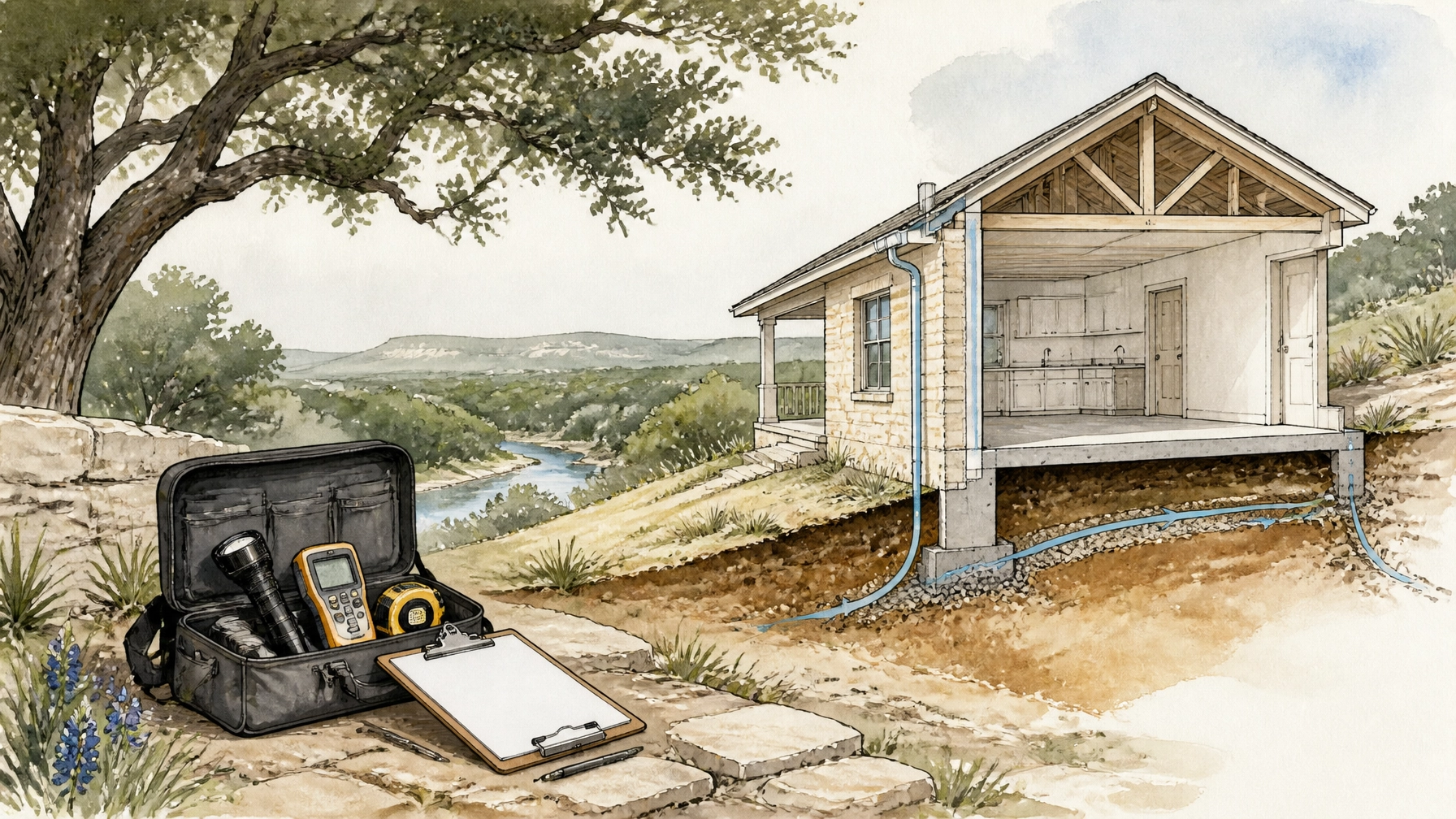
Buying a home in New Braunfels can feel like choosing your next chapter: morning coffee on the porch, easy access to the rivers, and perhaps a little more room for visiting family. Before you fall completely in love with the view, though, give the home inspection your full attention.
A good inspection is not a crystal ball, a warranty, or a guarantee that a home will never need repairs. It is a closer look at observable conditions and major systems at a particular point in time. The right questions can help you understand what the inspector sees, what may need additional review, and which records you should request before moving forward.
Texas home inspections are governed by the Texas Real Estate Commission’s Standards of Practice. Those standards establish the minimum scope for a typical inspection, but they do not mean every possible concern is fully diagnosed. For that reason, choose a qualified, currently licensed Texas inspector and ask what is included, what is excluded, and which specialists may be appropriate.
1. What do you see about the foundation and soil?
Foundation conversations in Central Texas can become dramatic quickly. One person sees a hairline crack; another sees the end of civilization. The useful middle ground is a careful, documented evaluation.
Ask the inspector to discuss:
- Visible cracks in the foundation, walls, ceilings, or flooring
- Doors and windows that stick or do not operate normally
- Noticeable slopes, separations, or uneven areas
- Signs of movement around porches, additions, patios, or retaining walls
- Whether the home appears to have a slab, pier-and-beam, or another foundation type
- Any evidence of previous foundation work
The inspector may identify signs that deserve attention, but a standard home inspection is not necessarily a structural engineering analysis. If there are meaningful concerns, ask whether a licensed structural engineer should evaluate the property separately.
Soil and moisture changes can affect how a foundation performs. Local geology varies throughout the New Braunfels area, so avoid relying on a broad neighborhood reputation. Ask what is visible at this specific home and what additional information would help clarify the situation.
2. How does water move around the property?
Drainage deserves its own question because water is often a home’s least charming roommate.
Ask the inspector to look at:
- The slope of the ground around the structure
- Low spots where water may collect
- Gutters, downspouts, and discharge points
- Erosion, washout, or exposed soil near the foundation
- Moisture in crawlspaces, if applicable
- Signs of past ponding or water intrusion
- Whether landscaping appears to direct water toward the home
You should also ask whether the property is near a mapped flood hazard area. The FEMA Flood Map Service Center is a useful starting point, while the City of New Braunfels Floodplain Management page provides local information for properties within city limits. For unincorporated areas, Comal County’s floodplain resources may be relevant.
Maps are helpful, but they do not replace a property-specific review. If floodplain status, drainage easements, or prior development work matters to your decision, confirm the information with the appropriate city or county office.

3. What condition is the roof in, and are there signs of storm wear?
A roof can look perfectly respectable from the driveway and still deserve a closer look. Ask the inspector about:
- The apparent age and remaining service expectations of the roof covering
- Missing, damaged, curled, or deteriorated materials
- Flashing around vents, chimneys, skylights, and roof intersections
- Gutters and edge details
- Attic ventilation and visible signs of moisture
- Previous patching or repairs
- Evidence that wind, hail, or severe weather may have affected the roof
A home inspector typically reports observable conditions, not a guarantee of future performance. If the roof is older, difficult to access, heavily repaired, or shows possible storm damage, ask whether a qualified roofing professional should review it.
Our guide to New Braunfels weather and seasonal storms offers broader relocation context, but an inspection should stay focused on the actual roof in front of you: not general assumptions about the region.
4. Are there plumbing clues that deserve follow-up?
Plumbing problems are not always dramatic. Sometimes they announce themselves with a ceiling stain. Other times, they whisper through slow drains, unexplained moisture, or a water meter that seems unusually energetic.
Ask the inspector about:
- Visible leaks beneath sinks and around fixtures
- Water pressure and flow at representative fixtures
- Drain performance
- Supply and drain lines that are visible
- The water heater’s visible condition and installation
- Corrosion, staining, or moisture around plumbing connections
- Signs that a leak may have affected walls, flooring, or cabinets
- Any indications of possible under-slab plumbing concerns
An inspector can flag evidence, but a plumbing specialist may be needed to diagnose concealed or under-slab issues. Do not assume that a clean-looking kitchen means every hidden line is trouble-free: or that one old fitting means the entire plumbing system needs replacement. Ask for clear observations and appropriate next steps.
5. How are the heating, cooling, and ventilation systems performing?
For many people retiring in New Braunfels, reliable cooling is less of a luxury and more of a daily quality-of-life feature. Ask:
- Are the heating and cooling systems operating during the inspection?
- What is the apparent age and condition of the equipment?
- Are there unusual sounds, odors, or performance concerns?
- Do thermostats and accessible controls respond normally?
- Are ducts, insulation, and visible connections in reasonable condition?
- Is the condensate drain routed in a way that raises moisture concerns?
- Are service records or replacement dates available?
A home inspection is not the same as a full HVAC service appointment or load calculation. If the equipment is older, unusual, inaccessible, or showing symptoms, a licensed HVAC professional can provide a more specialized assessment.

6. Could the home support your future accessibility needs?
A retirement home should work not only for today’s lifestyle but also for the life you may want five, ten, or fifteen years from now. Accessibility is not simply a matter of whether a home is marketed as “age-friendly.”
Ask the inspector to comment on practical features such as:
- Steps at the main entrance and commonly used exits
- Thresholds and changes in floor height
- Door widths and hallway clearance
- Lighting on walkways, stairs, and entries
- Bathroom layout and maneuvering space
- Shower and tub access
- Stair configuration and handrails
- The location of bedrooms, laundry, and frequently used living spaces
This is a suitability conversation, not a legal compliance determination. Ordinary private homes are not generally treated as public accommodations under the Americans with Disabilities Act; ADA.gov explains the law’s application to housing and public accommodations. If you need a formal accessibility review, consult an architect, occupational therapist, or accessibility specialist familiar with residential design.
The best home is not necessarily the one with the fanciest finishes. It may be the one where carrying groceries, welcoming guests, and navigating the bathroom at night feel pleasantly uncomplicated.

7. What maintenance history and documentation can the seller provide?
The inspection report is one piece of the puzzle. Ask for the home’s paper trail, too.
Useful records may include:
- Previous inspection reports
- Foundation evaluations or repair documentation
- Roof invoices and warranties
- HVAC service records
- Plumbing work records
- Permits for additions, remodels, or major repairs
- Appliance manuals and warranties
- Pest-control reports, where applicable
- Records for drainage improvements or retaining walls
- Dates of major replacements
A permit or invoice does not automatically prove that work was flawless, but missing documentation can make it harder to understand what happened and when. Ask your real estate professionals how records can be verified through the relevant city or county offices.
Comal County’s guidance offers a useful principle: “All floodplain information is handled in ‘writing.’” That mindset applies more broadly to a home purchase. If a claim about repairs, drainage, or prior damage matters to your decision, request supporting documentation rather than relying only on a casual conversation.
A simple way to organize the inspection process
To keep the process manageable:
- Hire a qualified, currently licensed Texas inspector. Confirm the inspection scope and reporting format.
- Attend if possible. You may learn more from seeing a concern than from reading a sentence about it later.
- Ask for clarification. “Monitor,” “repair,” and “further evaluation” can mean different things depending on the condition.
- Bring in specialists when appropriate. A structural engineer, roofer, plumber, HVAC professional, or accessibility specialist may answer questions outside the general inspection’s scope.
- Review the documentation before making decisions. Keep the report, invoices, warranties, and professional opinions together.
- Allow time for follow-up. Rushed decisions are rarely improved by adding a Hill Country sunset to the schedule.
Final thoughts
A New Braunfels home inspection should help you understand the property: not scare you away from every home with a tree root or a twenty-year-old water heater. Every house has a story, and some chapters involve maintenance.
For retirees and pre-retirees, the most useful inspection questions connect condition with lifestyle: Is the home comfortable? Is it manageable? Are there issues that deserve expert attention? Does the property support how you hope to live in the Hill Country?
At Retire in New Braunfels, we help readers explore the lifestyle side of relocating to the area. At Mau Sanchez Capital, we specialize in helping families think through financial transitions surrounding major life changes, including relocation. That planning conversation is separate from a home inspection, and any legal, tax, or estate questions should be directed to a qualified CPA or estate attorney.
Schedule a private meeting with a fiduciary financial advisor today by calling (512) 593-8380 or by visiting: https://calendly.com/portafoliocapital/15min
Portafolio Capital Management dba Mau Sanchez Capital is a Registered Investment Adviser. This content is for informational purposes only and does not constitute investment advice or a solicitation to buy or sell any security. Advisory services are provided only pursuant to a written advisory agreement.
This article may include stories, scenarios, and perspectives created or assisted by artificial intelligence. Although the individuals and circumstances described may be fictional, the topics are intended to reflect real financial, personal, and lifestyle issues that retirees and individuals commonly face.
The content is provided to encourage readers to consider different perspectives that may affect their retirement, regardless of whether they are currently planning, approaching retirement, or already retired. It is intended for general educational and informational purposes only and should not be interpreted as personalized investment, financial, tax, legal, medical, or retirement-planning advice.
Individual circumstances vary. Readers should independently verify any information presented and consult appropriately qualified professionals before making financial or personal decisions. No advisory, professional, or client relationship is created through the use of this website.
Leave a Reply