
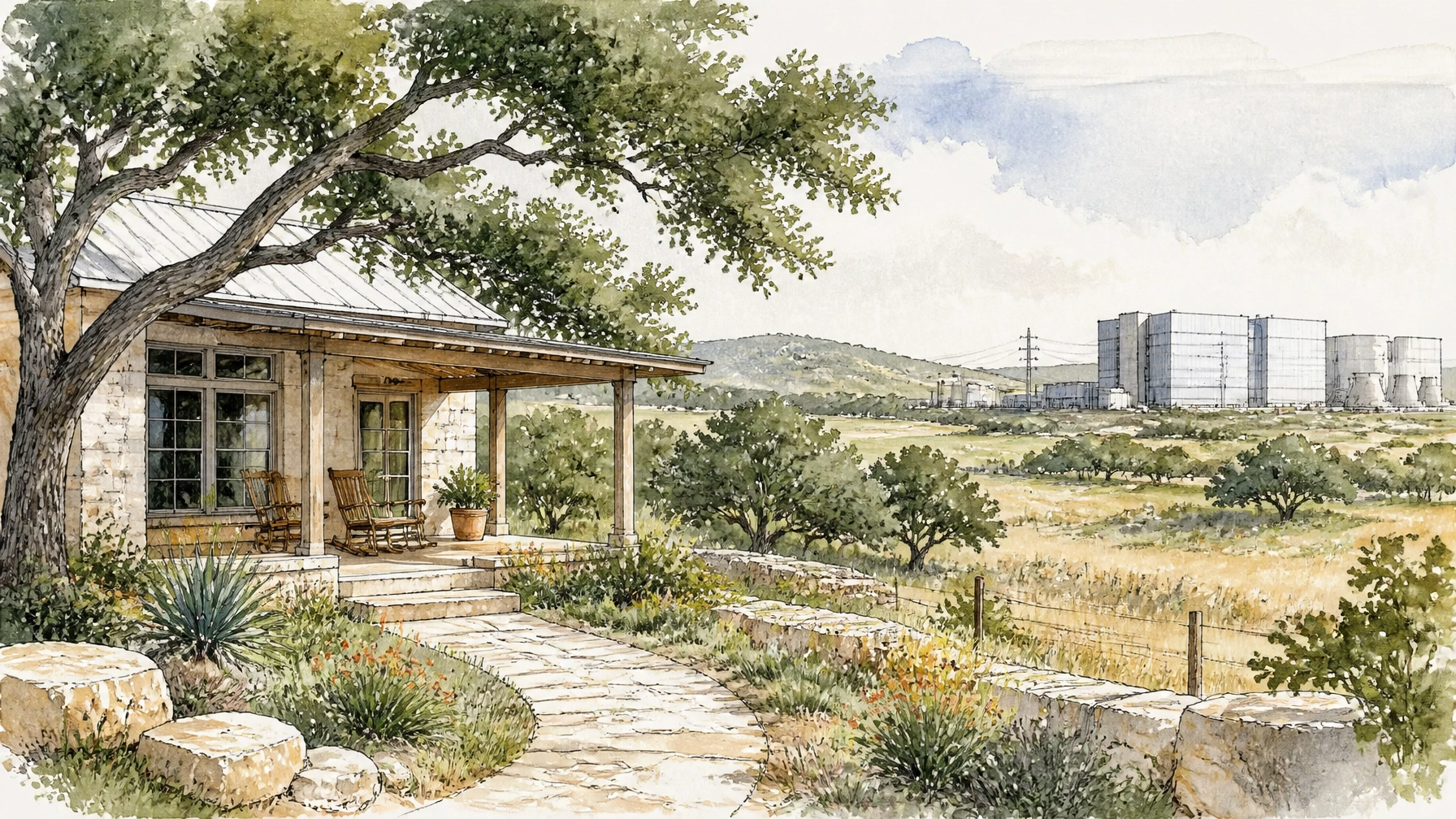
New Braunfels is famous for clear springs, limestone hills, friendly neighborhoods, and a pace of life that feels a little less hurried. It is also part of a fast-growing Central Texas corridor where new homes, roads, businesses, and infrastructure continue to reshape the landscape.
Among the newest conversations is the growth of large data centers: facilities that support cloud computing, artificial intelligence, streaming, online banking, and countless everyday digital services.
Are data centers automatically bad for Hill Country retirement?
Not necessarily. But they do raise reasonable questions about water, electricity, noise, traffic, land use, and long-term quality of life. For retirees and pre-retirees choosing where to live, the goal is not to react to every headline. It is to understand what is proposed, what has actually been approved, and how a project could fit: or fail to fit: with the surrounding community.
First, separate a proposal from an outcome
One data-center conversation that has drawn attention in the New Braunfels–San Marcos corridor involves property near Francis Harris Lane. The Hays County public archive lists a May 20, 2025 public workshop regarding a proposed CloudBurst data center at that address.
The Guadalupe County abatement-notice page also lists a 2026 notice involving CloudBurst Texas, LLC and Data Center LB, L.P. A tax-abatement notice is part of a public process; it is not the same thing as a complete engineering review or a guarantee that every anticipated phase will be built exactly as described.
That distinction matters. A proposal may change. A project may be phased. Permits may address only certain aspects of development. And a public meeting may provide information without representing a final decision on every community concern.
For anyone considering a retirement move, “What is the status?” is often the most important first question.
The five quality-of-life questions worth asking
1. How much water would the facility require?
Water is naturally one of the biggest Hill Country questions. Residents already pay attention to springs, aquifers, drought conditions, landscaping, and the long-term needs of a growing region. Data centers can use water for cooling, although the amount varies widely depending on the facility’s design, climate controls, operating load, and water source.
Project materials for the CloudBurst development describe a focus on “responsible water use” and water-efficient cooling. That is a useful starting point, but residents should look for more specific information:
- What cooling system is proposed?
- Would the facility use municipal water, reclaimed water, groundwater, or another source?
- What is the expected average and peak daily use?
- How would water demand change during hot weather?
- Would the project’s water needs compete with residential, agricultural, or environmental priorities?
- Are conservation plans enforceable, measurable, and publicly reported?
The Texas Water Development Board’s water-demand projection resources offer helpful context for understanding how population growth and water needs are evaluated across Texas. They do not answer every project-specific question, but they remind us that water planning is a long game: not a one-summer conversation.

2. Where will the electricity come from?
Data centers are designed to operate continuously, which means their energy needs can be substantial. That makes power supply, transmission lines, substations, backup generation, and emissions important parts of the public conversation.
The Electric Reliability Council of Texas large-load integration page explains how very large electricity users are being incorporated into grid planning. The process is intended to help evaluate transmission constraints, reliability, and the infrastructure needed to serve new demand.
For residents, the practical questions are less technical:
- Will new power lines or substations be visible from nearby homes?
- Will construction require extended road closures or utility work?
- How will backup generators be tested and operated?
- Would the project rely on on-site natural-gas generation?
- Who pays for infrastructure built primarily to serve the facility?
- Could the project affect reliability or costs for existing customers?
A data center may create economic activity without bringing the same daily traffic as a shopping center or large residential subdivision. Still, its energy footprint can be much larger than its visible workforce. That is why the electrical plan deserves as much attention as the building design.
3. What will neighbors hear?
A modern data center may look quiet from the road, but it is not silent. Cooling equipment, fans, chillers, generators, transformers, and construction activity can all affect the surrounding soundscape.
For someone retiring to a peaceful Hill Country home, the issue is not merely whether noise violates a rule. It is whether the sound is noticeable at breakfast, during an afternoon nap, or while sitting on the porch with a book.
Residents can ask for:
- Daytime and nighttime noise studies
- Expected sound levels at the nearest homes
- The location and height of cooling equipment
- Generator-testing schedules
- Landscaping, berms, walls, or other screening
- Procedures for handling noise complaints
- Independent monitoring after operations begin
The developer has referenced “noise and visual screening” in early planning materials. That is encouraging in principle, but a thoughtful review should focus on the details: Where will the equipment sit? How high will the screening be? What happens when trees lose their leaves? Who verifies the results?
4. How much traffic will construction bring?
Once operational, a data center may employ fewer people than a manufacturing plant, hospital, or retail complex of a similar value. During construction, however, the picture can be very different.
Large projects may bring concrete deliveries, heavy equipment, utility crews, material shipments, and multiple construction shifts. Temporary traffic can affect rural roads that were never designed for sustained industrial activity.
Retirees should consider:
- Which roads would carry construction vehicles?
- How long would the construction period last?
- Would road improvements be required?
- Are emergency routes preserved?
- How would school-bus, farm, and neighborhood traffic be managed?
- Would construction occur during evenings or weekends?
These questions are especially important when evaluating a home just outside New Braunfels, where a peaceful country road can be part of the property’s appeal.
5. Does the land-use plan fit the community?
A project can be economically attractive and still prompt legitimate land-use concerns. Retirees may care about views, dark skies, open space, property values, emergency response, nearby utilities, and whether the surrounding area feels residential, rural, commercial, or industrial over time.
The regulatory picture can also be complicated when a site sits near city boundaries or crosses county lines. The Hays County Development and Planning department is one place to begin when researching applications and development records. Guadalupe County maintains its own public records and meeting information.
That leads to a basic but important rule: identify the exact jurisdiction before assuming the city, county, or another agency controls a particular decision.

Could data centers bring benefits?
A balanced conversation should include potential advantages as well as concerns.
Large technology projects may contribute construction employment, utility investment, business activity, and additional public revenue. They can support the digital services people rely on every day, including telehealth, online learning, remote work, and communication with family members.
Some retirees may also appreciate the broader economic stability that comes with a diversified local economy. Others may prefer a community where growth is smaller, slower, and more visibly connected to local businesses.
Neither preference is unreasonable. The key is whether the benefits are clearly defined and whether the community can evaluate them alongside water, power, land, and quality-of-life considerations.
As Hays County Judge Ruben Becerra said in coverage by KXAN, “millions of people’s drinking water is at stake with just a couple of these data centers.” That is a serious concern, although it should be considered alongside project-specific engineering data rather than treated as a prediction of one facility’s guaranteed impact.
How to follow the public record without making it a second job
You do not need to become a land-use attorney or infrastructure engineer to stay informed. A simple process can help:
- Find the exact project name and address. Similar-sounding proposals can involve different owners, jurisdictions, and approval paths.
- Read agendas and supporting documents. Look for water studies, traffic plans, site plans, utility agreements, and noise information.
- Watch public meetings. Hays County Commissioners Court information includes meeting access and records.
- Ask specific questions. “Will this affect my property?” is understandable. “What is the projected nighttime sound level at the nearest residence?” is easier to answer.
- Track conditions, not just announcements. A promise is different from a written requirement with a responsible party and a reporting process.
- Consult qualified professionals when needed. A real-estate attorney, land-use professional, environmental consultant, CPA, or other specialist may be appropriate for project-specific or personal questions.

What this means for a retirement move
A data-center proposal should not automatically eliminate an entire region from your retirement search. It should encourage a closer look at the specific neighborhood, road network, water provider, utility plan, future land-use pattern, and distance from the project.
When touring homes, visit at different times of day. Listen from the porch. Check the drive to healthcare, groceries, parks, and favorite restaurants. Ask whether nearby land is entitled, under review, or simply being discussed. And remember that the most attractive view today may not be the long-term view if surrounding land is still undeveloped.
New Braunfels can remain a wonderful place for a slower-paced retirement while also navigating serious growth questions. The best decisions come from clear information, realistic expectations, and a willingness to look beyond the brochure: including the very charming brochure with the oak tree on the cover.
At Mau Sanchez Capital, we specialize in helping families think through the financial transitions that can accompany a retirement relocation, including income planning, investment management, and wealth-preservation considerations. If you are weighing a move to New Braunfels or another Central Texas community, you can learn more about Mau Sanchez Capital or call (512) 593-8380.
Schedule a private meeting with a fiduciary financial advisor today by calling (512) 593-8380 or by visiting: https://calendly.com/portafoliocapital/15min
Portafolio Capital Management dba Mau Sanchez Capital is a Registered Investment Adviser. This content is for informational purposes only and does not constitute investment advice or a solicitation to buy or sell any security. Advisory services are provided only pursuant to a written advisory agreement.
This article may include stories, scenarios, and perspectives created or assisted by artificial intelligence. Although the individuals and circumstances described may be fictional, the topics are intended to reflect real financial, personal, and lifestyle issues that retirees and individuals commonly face.
The content is provided to encourage readers to consider different perspectives that may affect their retirement, regardless of whether they are currently planning, approaching retirement, or already retired. It is intended for general educational and informational purposes only and should not be interpreted as personalized investment, financial, tax, legal, medical, or retirement-planning advice.
Individual circumstances vary. Readers should independently verify any information presented and consult appropriately qualified professionals before making financial or personal decisions. No advisory, professional, or client relationship is created through the use of this website.
Leave a Reply