
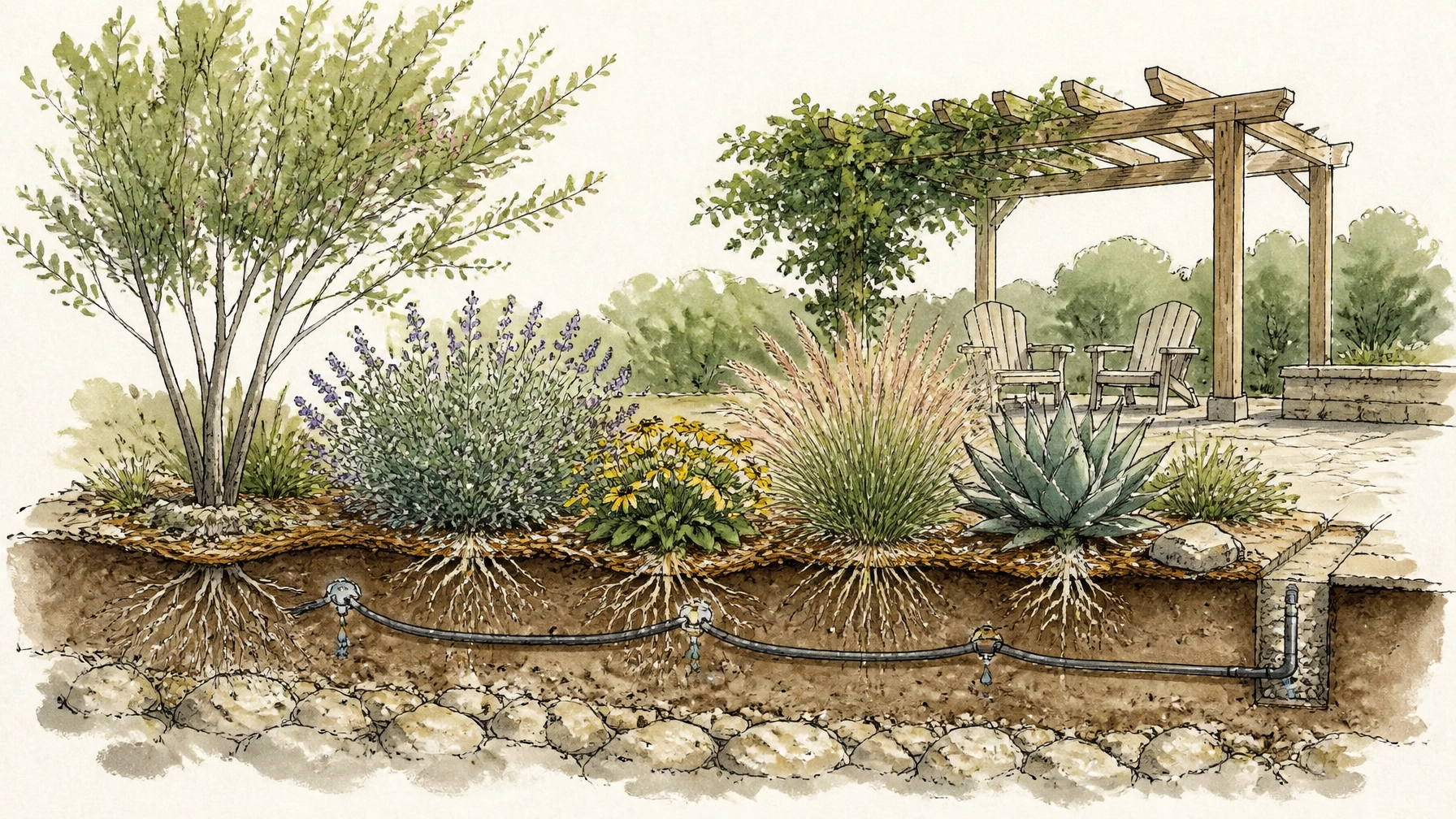
A beautiful New Braunfels yard does not need to be a thirsty one.
In the Texas Hill Country, thoughtful landscaping can mean more time enjoying your patio, fewer chores during hot stretches, and less dependence on frequent irrigation. The goal is not to create a yard that never needs water. The goal is to design a landscape that works with the local soil, sun, rainfall patterns, and the way you actually want to live.
For retirees and pre-retirees considering a move to New Braunfels, that last point matters. A yard should be inviting: not a part-time job with a rake.
Here is a practical way to create a drought-ready Hill Country landscape while keeping it attractive, comfortable, and enjoyable.
Start with the Yard You Have
Before visiting a nursery or sketching a planting bed, spend a little time observing your property.
Notice:
- Which areas receive full sun throughout the day
- Where afternoon heat hits hardest
- Where water naturally collects after a storm
- Which areas are shaded by existing oaks or structures
- Whether the soil is shallow, rocky, compacted, or clay-heavy
- Where you would most enjoy sitting, walking, or entertaining
A south- or west-facing wall may need plants that tolerate intense heat and reflected sunlight. A spot beneath an established tree may be cooler but challenging because of root competition and dry shade.
Instead of trying to make every part of the yard support the same plants, divide it into sections based on conditions. This simple approach is called hydrozoning: grouping plants with similar water needs together.
Your driest zone might include agaves, ornamental grasses, Texas sage, and other tough selections. A more protected area near a downspout could accommodate plants that appreciate occasional additional moisture.
The result is a yard that is easier to water intelligently: and easier to maintain as the years go by.
Choose Native and Well-Adapted Plants
The right plant list is the heart of a drought-ready yard.
Native plants are adapted to regional conditions and can provide habitat for birds, pollinators, and other wildlife. Well-adapted plants from similar climates can also perform beautifully when placed in the right location.
The Lady Bird Johnson Wildflower Center’s Central Texas drought-resistant plant collection is a useful starting point for exploring species suited to dry conditions.
Depending on your property’s sun, soil, and available space, possibilities may include:
- Texas sage for silvery foliage and periodic blooms
- Blackfoot daisy for small flowers and a tidy form
- Flame acanthus for color and pollinator appeal
- Autumn sage for a compact flowering shrub
- Mexican feathergrass or muhly grass for movement and texture
- Prickly pear and agave for sculptural accents
- Desert willow or Texas redbud as small-tree options
- Buffalo grass or blue grama for limited turf-like areas
Think in layers rather than a single row of identical shrubs. Small trees can provide structure and shade. Shrubs can frame paths and seating areas. Grasses and perennials can fill the middle. Groundcovers, stone, and carefully placed accents can finish the edges.

Buy for the Site, Not Just the Label
“Drought tolerant” does not mean “happy everywhere.”
A plant that thrives in full sun may struggle beneath an oak. A plant that enjoys well-drained rocky soil may fail in a low spot that stays wet after heavy rain. Read the mature size, light requirements, and soil preferences before buying.
Smaller container plants can also be a sensible choice. They may establish more gradually, but they are often easier to plant and less expensive to replace if a location turns out to be a poor fit. Even drought-tolerant plants need regular attention while developing their root systems.
Prepare the Soil Without Overbuilding It
Hill Country soil can be shallow, rocky, and alkaline. That is not necessarily a problem; it simply means the landscape should be designed around the site instead of forcing the site to behave like a deep garden bed.
Before planting:
- Remove the worst compaction from the planting area.
- Clear rocks only where they interfere with root growth.
- Improve individual planting pockets rather than heavily amending the entire yard.
- Preserve natural drainage.
- Avoid creating a low basin that holds water around plants that prefer dry conditions.
A small amount of compost may help in especially thin or depleted soil, but more is not always better. Excessive organic material can hold too much moisture around drought-adapted plants or create an abrupt change between amended soil and surrounding ground.
For sloped sites, low terraces or shallow planting pockets made with local stone can help slow runoff. The objective is to let rainfall soak into the root zone rather than rush across the property.
If you are unsure what your soil needs, a local nursery, county horticulture resource, or qualified landscape professional can help you evaluate it before you spend money on plants.
Use Mulch as a Water-Saving Layer
Mulch is one of the simplest ways to reduce evaporation and moderate soil temperatures.
For most planting beds, a layer of approximately two to three inches of shredded hardwood, wood chips, or partially composted bark can:
- Slow moisture loss
- Reduce weed competition
- Protect shallow roots from temperature swings
- Improve the appearance of a new planting bed
Keep mulch away from trunks and plant crowns. A thick pile against a tree or shrub can trap moisture where it does not belong and encourage decay.
For agaves, yuccas, prickly pear, and other plants that prefer especially dry crowns, gravel or decomposed granite may be more appropriate than heavy organic mulch. It also creates a pleasing visual contrast with green foliage and limestone.
Make Irrigation Quiet, Slow, and Targeted
A drought-ready yard generally benefits from drip irrigation or non-spraying soaker hoses rather than broad overhead spray.
Drip systems place water near the base of plants, reducing evaporation and limiting the amount of water lost to wind or pavement. Soaker hoses can work well in smaller beds, although they should be checked regularly for uneven flow, leaks, and clogged sections.
Consider placing each hydrozone on its own valve or irrigation section. A bed of established native shrubs should not necessarily receive the same schedule as a newly planted tree or a small patch of turf.
A few useful habits:
- Water slowly enough that the soil can absorb it
- Inspect emitters and connections several times a year
- Adjust lines as plants grow
- Keep irrigation from spraying sidewalks, driveways, or walls
- Water new plants more consistently during establishment
- Reduce supplemental watering as roots mature
A well-designed system is not one that runs frequently. It is one that delivers the right amount of water to the right plants with minimal waste.
Create Shade for Plants: and for Yourself
Shade is a landscape feature, not merely a nice bonus.
A small tree, pergola, trellis, or strategically placed shrub can make a patio more comfortable while reducing heat stress on nearby plants. West-facing shade can be especially valuable because it protects surfaces and planting beds from intense late-day exposure.
Existing oaks can provide character and cooling, but avoid automatically placing thirsty turf beneath them. Dry-shade plants, sedges, mulch, and stone may create a more successful and lower-maintenance design.
Most importantly, build the yard around how you want to spend time outdoors. A shaded chair near a fragrant planting bed may be more valuable than another stretch of lawn.

Capture Rainwater Where Permitted
Rainwater capture can supplement landscape watering and help slow runoff from the roof.
A basic system may include a downspout diverter, screened rain barrel, overflow route, and hose connection for nearby planting beds. Larger cisterns can support more extensive irrigation, but they require more planning and maintenance.
The Texas Water Development Board’s rainwater harvesting resources offer background on residential collection systems and potential uses.
Before installing a barrel or cistern, verify:
- Whether local building, plumbing, or placement requirements apply
- How overflow will be directed away from foundations
- Whether the system needs mosquito screening
- Whether an opaque tank or first-flush device is appropriate
- Whether your HOA has reasonable placement or appearance guidelines
- Whether connecting the system to an irrigation line could create a backflow issue
Do not assume that harvested water is automatically exempt from local landscape watering requirements. As the New Braunfels Utilities conservation page states, “Every gallon conserved today helps support our community’s long-term water future.”
Check NBU Rules Before You Finalize the Design
Water conservation stages can change, so check the current NBU guidance before programming an irrigation controller or planning a new landscape.
At the time of publication, NBU lists Conservation Stage 2 as effective August 10, 2026. Its current guidance says:
- Irrigation systems and sprinklers are limited to once per week according to the last digit of the service address.
- Irrigation is permitted before 10 a.m. and after 8 p.m.
- Hand-held hoses, buckets, drip systems, and non-spraying soaker hoses are allowed according to the current Stage 2 guidance and permitted watering hours.
- Water waste is prohibited year-round.
Rules and interpretations can change. Review the NBU current conservation stage page and watering resources before beginning work. If your property has a larger cistern, automated system, foundation-watering concern, or a connection involving potable water, contact NBU or the appropriate local department for property-specific guidance.
Designing around permitted watering windows is easier than trying to retrofit a thirsty landscape later.
Build for Enjoyment, Not Just Survival
A drought-ready yard should still feel generous.
Include a path that invites a morning walk. Add a bench beneath a tree. Create a small space for coffee, conversation, or watching birds. Use stone, texture, and seasonal color so the landscape remains interesting even when rainfall is limited.
This kind of outdoor space can become part of the slower, nature-focused lifestyle that attracts many people to New Braunfels. It fits naturally with the broader rhythm of Hill Country living described in our guides to New Braunfels weather and adapting to the area’s small-town pace.
When considering a move, remember that landscaping is also part of the practical homeownership picture. At Mau Sanchez Capital, we specialize in helping families think through financial transitions connected with relocation and retirement. That may include general planning around ongoing home costs, liquidity needs, and how a new lifestyle fits into a long-term plan. Our approach generally emphasizes transparent, liquid, publicly traded markets, thoughtful asset allocation, and client-specific portfolio construction rather than unnecessary complexity.
A Simple Drought-Ready Yard Checklist
Before planting, ask:
- Have I grouped plants by water needs?
- Do I know where the sun and shade fall during the day?
- Have I preserved drainage?
- Is the soil prepared for the plants I selected?
- Will mulch protect the beds without covering trunks or crowns?
- Can my irrigation system water slowly and precisely?
- Have I planned shade for both plants and people?
- Is rainwater capture permitted and safely designed?
- Have I checked the latest NBU watering rules?
- Will this yard be enjoyable to maintain five or ten years from now?
The best Hill Country yard is not the one with the most plants. It is the one that feels beautiful, comfortable, and manageable in real life.
Schedule a private meeting with a fiduciary financial advisor today by calling (512) 593-8380 or by visiting: https://calendly.com/portafoliocapital/15min
Portafolio Capital Management dba Mau Sanchez Capital is a Registered Investment Adviser. This content is for informational purposes only and does not constitute investment advice or a solicitation to buy or sell any security. Advisory services are provided only pursuant to a written advisory agreement.
This article may include stories, scenarios, and perspectives created or assisted by artificial intelligence. Although the individuals and circumstances described may be fictional, the topics are intended to reflect real financial, personal, and lifestyle issues that retirees and individuals commonly face.
The content is provided to encourage readers to consider different perspectives that may affect their retirement, regardless of whether they are currently planning, approaching retirement, or already retired. It is intended for general educational and informational purposes only and should not be interpreted as personalized investment, financial, tax, legal, medical, or retirement-planning advice.
Individual circumstances vary. Readers should independently verify any information presented and consult appropriately qualified professionals before making financial or personal decisions. No advisory, professional, or client relationship is created through the use of this website.
Leave a Reply